
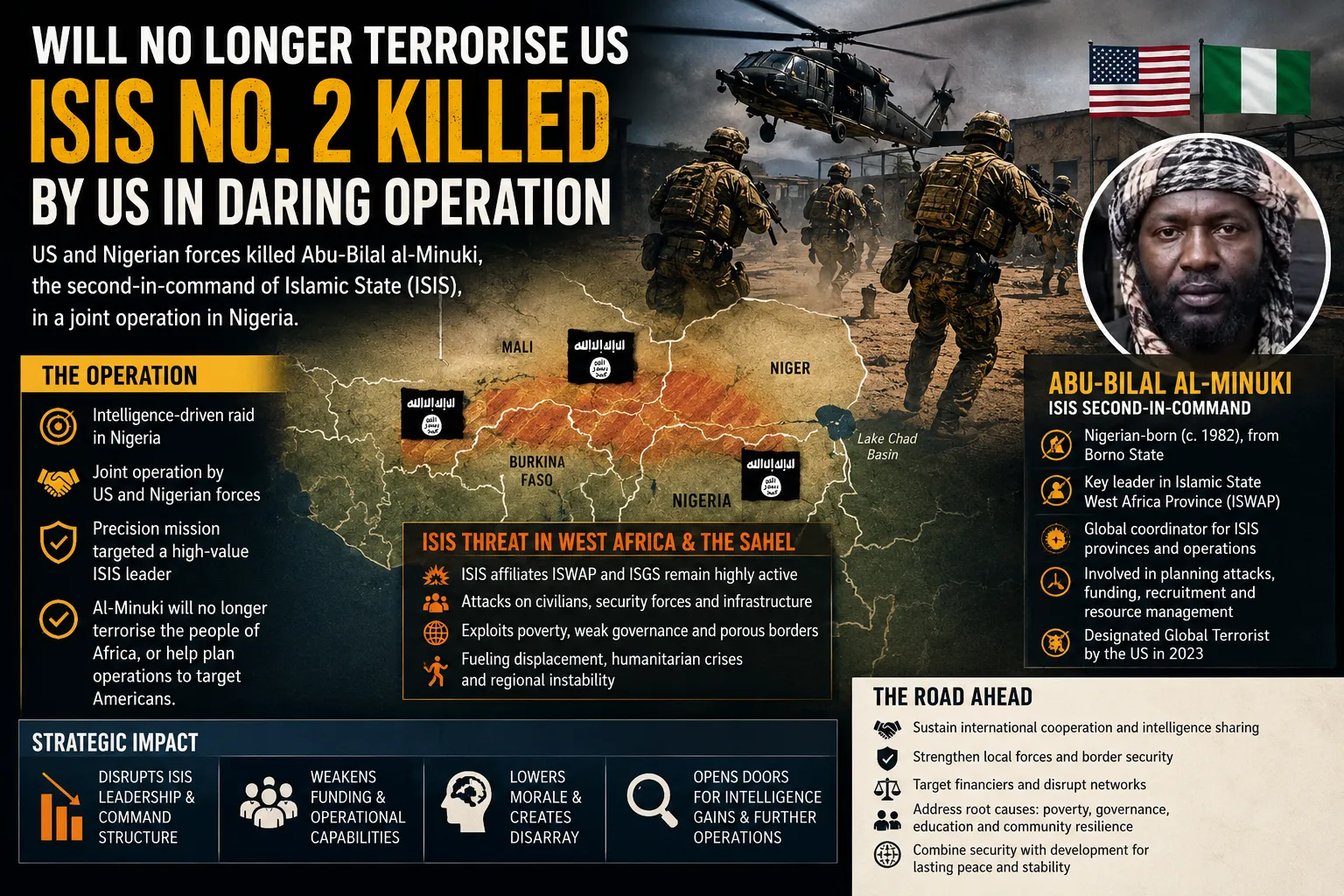
In a significant development in the global fight against terrorism, US President Donald Trump announced the successful elimination of Abu-Bilal al-Minuki, the second-in-command of the Islamic State (ISIS). The operation, carried out jointly by US and Nigerian forces in Nigeria, has been hailed as a meticulously planned mission that delivers a major blow to the terror group’s operational capabilities. President Trump stated that with al-Minuki’s death, the militant “will no longer terrorise the people of Africa, or help plan operations to target Americans,” significantly diminishing ISIS’s global reach and coordination.
This high-value target elimination underscores the ongoing international efforts to disrupt terrorist networks that continue to pose threats despite losing their once-vast territorial holdings. The strike highlights the effectiveness of intelligence-driven, collaborative operations in addressing evolving security challenges across unstable regions.
Details of the Operation
According to official statements, American and Nigerian forces executed the raid with precision after intelligence agencies tracked al-Minuki’s movements in Africa. The operative had sought relative safety in the region to continue directing ISIS activities. The mission focused on a key figure actively involved in planning attacks, facilitating funding, and coordinating operations across ISIS affiliates.
This joint effort reflects strengthened counterterrorism cooperation in West Africa, where local forces battle persistent insurgencies. Such operations prioritize the removal of senior leadership to break command chains, interrupt financial flows, and create disarray within terrorist structures.
Profile of Abu-Bilal al-Minuki
Abu-Bilal al-Minuki, also known by variations such as Abu Bakr Muhammad al-Mainuki, Abor Mainok, and Abubakar Mainok, was a Nigerian-born militant born around 1982 in Mainok, Borno State. He rose through the ranks of the Islamic State West Africa Province (ISWAP) and became a influential global coordinator within the organization.
Al-Minuki played a critical role in the Islamic State’s General Directorate of Provinces, particularly in guiding operations and channeling resources to African affiliates, including groups in the Lake Chad Basin and the Sahel. His responsibilities included operational planning, recruitment support, and financial oversight that sustained ISIS-linked activities beyond the Middle East. In 2023, he was formally designated a global terrorist by the US for his leadership in terror financing and attack facilitation.
As a hardline figure, al-Minuki helped adapt ISIS from a territorial “caliphate” model to a more decentralized network of insurgent cells. This evolution allowed the group to maintain influence through regional franchises while projecting a global brand of extremism.
ISIS Threat in West Africa and the Sahel
West Africa and the Sahel region have emerged as major centers of ISIS activity in recent years. Affiliates such as ISWAP and the Islamic State in the Greater Sahara (ISGS) have conducted numerous attacks on security forces, civilians, and infrastructure. These groups exploit local grievances, ethnic tensions, weak governance, and porous borders to expand their presence across Nigeria, Burkina Faso, Mali, Niger, and beyond.
The violence has fueled humanitarian crises, including mass displacement, food shortages, and cycles of intercommunal conflict. Despite broader declines in global terrorism fatalities in some areas, ISIS branches in Africa remain among the most active and lethal, demonstrating the group’s resilience through its franchise system.
The removal of a senior coordinator like al-Minuki is expected to disrupt funding pipelines and cross-regional planning. However, experts note that such organizations often recover by promoting new leaders from within their ranks, highlighting the need for sustained pressure.
Strategic Implications of the Strike
Targeted operations against high-ranking terrorists have long formed a key pillar of counterterrorism strategy. By removing experienced planners and financiers, these missions can degrade immediate capabilities, yield valuable intelligence, and temporarily disrupt momentum.
This particular operation emphasizes partnership with local forces, an approach that enhances legitimacy and builds long-term capacity in affected countries. It also signals continued focus on Africa as a priority theater where ISIS seeks new opportunities amid regional instability.
Potential benefits include:
-
Reduced ability to coordinate sophisticated attacks
-
Lowered morale among fighters and supporters
-
Opportunities to exploit leadership vacuums for further intelligence gains
Nevertheless, challenges remain. ISIS continues to inspire lone actors, maintain online propaganda, and engage in low-level insurgencies. A purely military approach is insufficient; lasting progress requires addressing underlying drivers such as poverty, poor governance, and lack of economic opportunities.
The Road Ahead
The elimination of Abu-Bilal al-Minuki represents a tactical victory in a prolonged struggle against violent extremism. While ISIS is far weaker than during its peak years of territorial control in Iraq and Syria, its decentralized model allows it to persist in multiple regions.
Sustained success depends on several pillars: continuous intelligence sharing among nations, training and equipping of local security forces, targeted sanctions on financiers, and efforts to counter radicalization both online and offline. For countries like Nigeria, strengthening border security, promoting community resilience, and implementing governance reforms are essential to prevent resurgence.
International cooperation remains indispensable. Multilateral initiatives that combine security measures with development programs offer the best hope for reducing the appeal of extremist ideologies.
In conclusion, this daring operation demonstrates that persistent, precise action can meaningfully weaken terrorist organizations. Al-Minuki’s removal removes a dangerous planner from the battlefield and limits ISIS’s ability to orchestrate violence. Yet it also serves as a reminder that the fight against terrorism demands vigilance, adaptability, and comprehensive strategies that extend beyond the battlefield. Only by tackling both the symptoms and root causes of extremism can the international community hope to create a safer world where such groups can no longer threaten innocent lives.
pressnbcnews pressnbcnews pressnbcnews pressnbcnews pressnbcnews pressnbcnews pressnbcnews pressnbcnews pressnbcnews pressnbcnews pressnbcnews pressnbcnews pressnbcnews pressnbcnews pressnbcnews pressnbcnews pressnbcnews pressnbcnews pressnbcnews pressnbcnews pressnbcnews pressnbcnews pressnbcnews pressnbcnews pressnbcnews pressnbcnews pressnbcnews pressnbcnews pressnbcnews pressnbcnews pressnbcnews pressnbcnews pressnbcnews pressnbcnews pressnbcnews pressnbcnews pressnbcnews pressnbcnews pressnbcnews pressnbcnews pressnbcnews pressnbcnews pressnbcnews pressnbcnews pressnbcnews pressnbcnews pressnbcnews pressnbcnews pressnbcnews pressnbcnews pressnbcnews pressnbcnews pressnbcnews pressnbcnews pressnbcnews pressnbcnews pressnbcnews pressnbcnews pressnbcnews pressnbcnews pressnbcnews pressnbcnews pressnbcnews pressnbcnews pressnbcnews pressnbcnews pressnbcnews pressnbcnews pressnbcnews pressnbcnews pressnbcnews pressnbcnews pressnbcnews pressnbcnews pressnbcnews pressnbcnews pressnbcnews pressnbcnews pressnbcnews pressnbcnews pressnbcnews pressnbcnews pressnbcnews pressnbcnews pressnbcnews pressnbcnews pressnbcnews pressnbcnews pressnbcnews pressnbcnews pressnbcnews pressnbcnews pressnbcnews pressnbcnews pressnbcnews pressnbcnews pressnbcnews pressnbcnews pressnbcnews pressnbcnews pressnbcnews pressnbcnews pressnbcnews pressnbcnews pressnbcnews pressnbcnews pressnbcnews pressnbcnews pressnbcnews pressnbcnews pressnbcnews pressnbcnews pressnbcnews pressnbcnews pressnbcnews pressnbcnews pressnbcnews pressnbcnews pressnbcnews pressnbcnews pressnbcnews pressnbcnews pressnbcnews pressnbcnews pressnbcnews pressnbcnews pressnbcnews pressnbcnews pressnbcnews pressnbcnews pressnbcnews pressnbcnews pressnbcnews pressnbcnews pressnbcnews pressnbcnews pressnbcnews pressnbcnews pressnbcnews pressnbcnews pressnbcnews pressnbcnews pressnbcnews pressnbcnews pressnbcnews pressnbcnews pressnbcnews pressnbcnews pressnbcnews pressnbcnews pressnbcnews pressnbcnews pressnbcnews pressnbcnews pressnbcnews pressnbcnews pressnbcnews pressnbcnews pressnbcnews pressnbcnews pressnbcnews pressnbcnews pressnbcnews pressnbcnews pressnbcnews pressnbcnews pressnbcnews